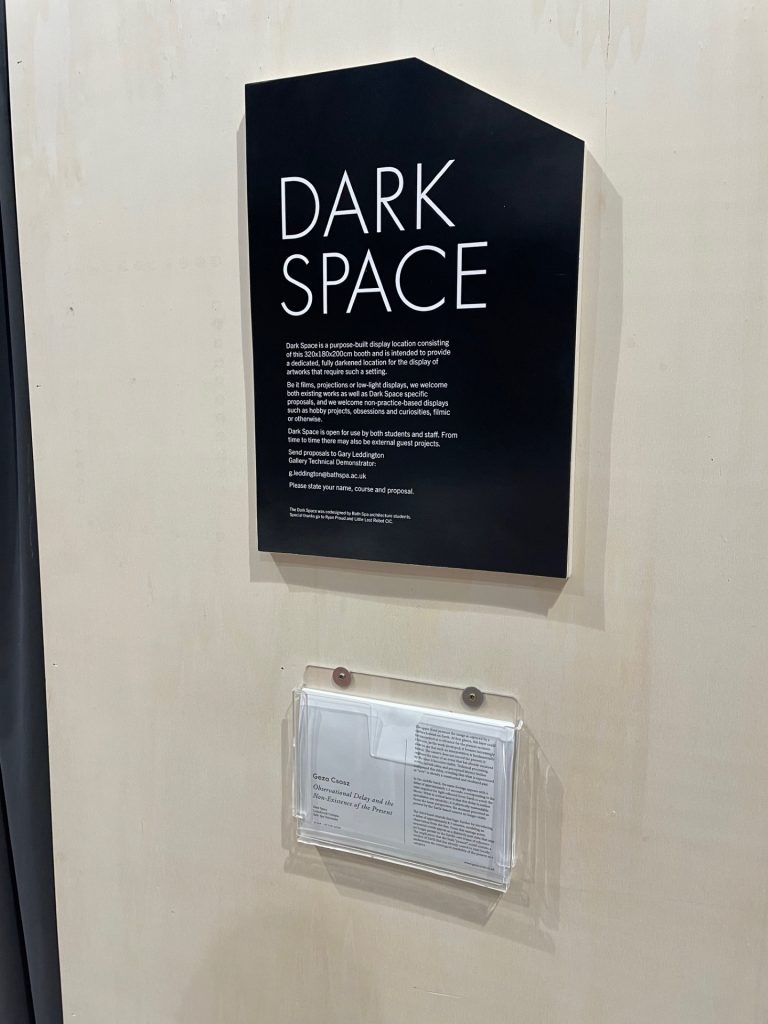
Bath Spa University- Dark Space 23.01.2026-09.02.2026
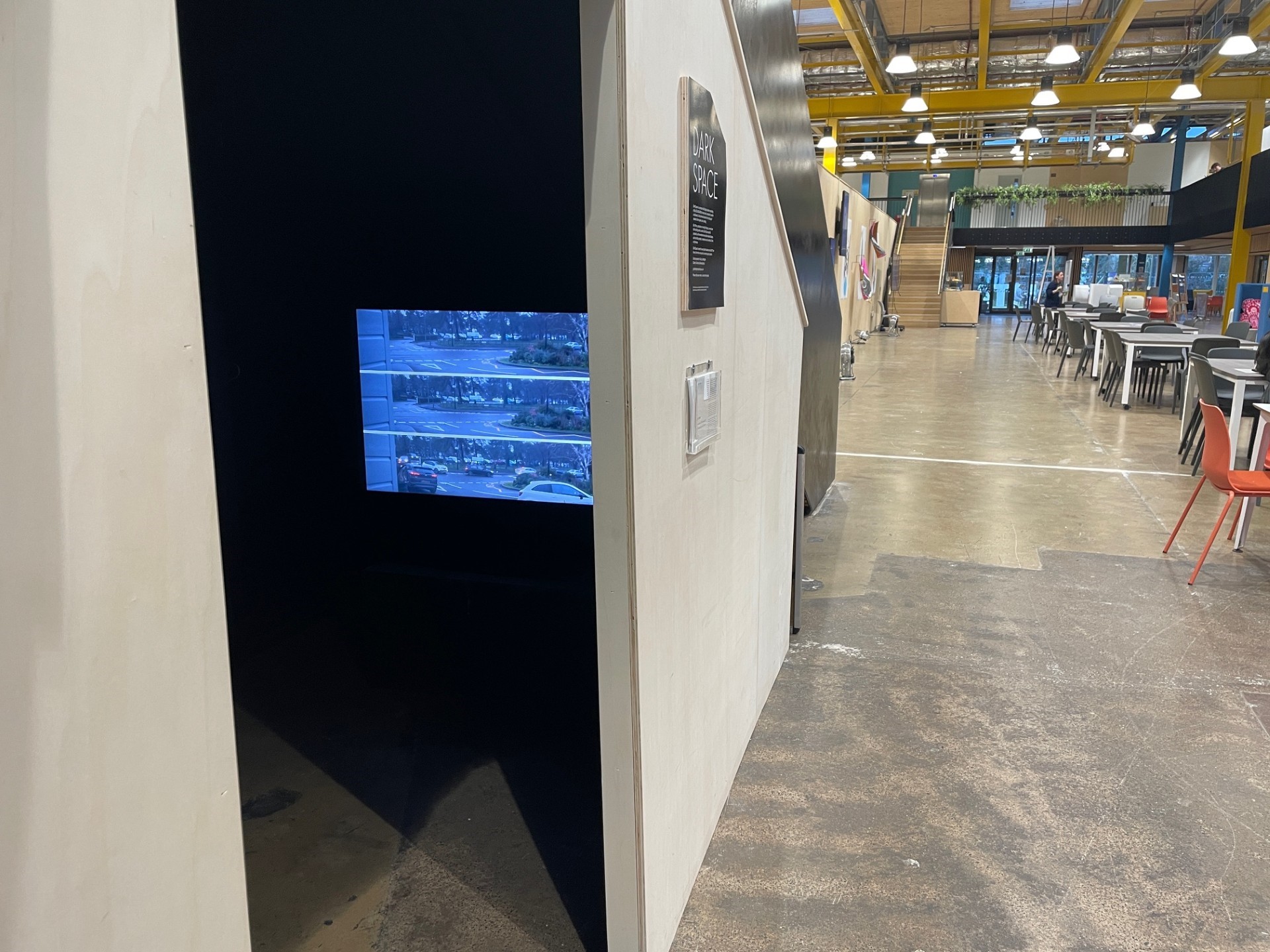
I initiated this video work with the intention of treating time not as a theme to be represented, but as an operational condition of the image itself. The screen is divided into three horizontal bands, each displaying the same recorded event, yet separated by precisely determined temporal delays. These delays are not aesthetic inventions but derive directly from the finite speed of light, grounding the work from its outset in a physically motivated experimental framework.
The upper band presents the image as captured by a camera located on Earth. At first glance, this layer could be interpreted as a reference for the present moment. However, as the work developed, it became increasingly clear to me that such an interpretation is fundamentally flawed. The camera does not record the present; it registers the trace of an event that has already occurred by the time it becomes visible. Technical processing, screen refresh rates, and perceptual latency further compound this delay, revealing that what is experienced as “now” is already a constructed and mediated past.
In the middle band, the same footage appears with a delay of approximately 1.3 seconds, corresponding to the time required for light reflected from Earth to reach the Moon. I conceive of this layer as a lunar observer witnessing the terrestrial event. What is critical here is that this delay is neither speculative nor symbolic; it is physically unavoidable. From the lunar perspective, the moment perceived as present by the Earth-based camera no longer exists. This realization directly challenges the intuitive assumption that a single, shared present could be accessible to all observers.
The third band extends this logic further by introducing a delay of approximately 8.3 minutes, modeling an observation from the Sun. From this vantage point, terrestrial events appear as a distinctly past state that may no longer persist in the Earth’s own frame of reference. The implication that the Sun’s “present” could contain a version of Earth that has already ceased to exist locally underscores, for me, the ontological instability of the present as a category.
As these three observational frames are perceived simultaneously, the possibility of privileging any one of them collapses. Each image is generated through the same physical mechanism of light reflection and transmission, and none can claim greater immediacy or truth than the others. The differences between them are purely quantitative, yet sufficient to dismantle the notion of a coherent, unified present.
Throughout the process, I have come to understand that the work does not depict the passage of time but instead makes perceptible the latency inherent in observation itself. The present does not emerge as a temporal point, but as an unstable construct dependent on the observer’s spatial position. In this sense, the video does not illustrate theories of relativity or phenomenological accounts of time; it operationalizes them within the structural logic of the moving image.
Within the context of my practice-based PhD research, I consider this work a practical experiment in which video functions not as a narrative medium, but as a temporal instrument. By embedding scientifically accurate delays into the image structure, the work forces the abandonment of any stable concept of the present. What is commonly experienced as “now” reveals itself as a localized approximation within a broader spacetime system.
This experiment has also clarified for me that the present is neither demonstrable nor capturable, even in principle. There is no image in the work to which the viewer can securely attach the experience of actuality. The present does not dissolve or fade away; rather, it never appears as an autonomous entity. In this sense, the work does not illustrate a proposition but generates a perceptual condition in which the absence of the present becomes directly experiential.